
Finding a new way: three examples of iconoclastic creativity
Hundertwasser, Can, and Buckminster Fuller broke the rules and the mold

Sometimes, you just need to get outside of it. Punch a hole through the wall of the current cultural hegemony, and start asking questions about why you’ve accepted things as they are.
Everything seems like it’s on infinite repeat. Nothing feels authentic, ideas are being regurgitated and “re-booted” ad infinitum, and you’re tired of all your old favorites and safe spaces. You need to break out of the loop, step off the moving sidewalk, stop the doomscrolling.
Everything feels 10xed (or more) in our lives right now, and you aren’t the only one who’s sick of it.
Maybe you need a different view.
As you may know if you follow me here, I am all about breaking out of the “usual modes of thinking”, rejecting the hegemony that has driven us here. Throughout history, in times of change, there have always been people who seemed able to step outside the chaos and come back with something wonderful—a light, an idea, music, a new way to think, a better way to live. It can be useful and inspiring to learn about these iconoclasts, who they were, and how they accomplished what they did. And so, I give you three unique examples of what taking a leap of faith can bring back from the Outside.
Hundertwasser, Can, and Buckminster Fuller—these three have always been in my mind as I seek ways to break out of old patterns and create new visions. This will not be an exhaustive biography of them, but an overview of who they were and how they broke the rules to create something wholly new.

Friedensreich Hundertwasser was an artist, painter, philosopher, architect, and visionary man who lived from 15 December 1928 – 19 February 2000. He considered himself to be an Ecological Man, as directly opposed to an Economic Man. His art and philosophy was intended to offer a new vision to lead humanity forward, in harmony with the Earth and Nature, and to assure that all humans and all life on the planet had a place and an identity in one living system. As a child, he lived through the horror of Nazi Germany and saw the ugliness of that industrial, militaristic mindset. He decided that humans were not meant to live in such drab, colorless environments, and set about bringing color and nature back to city dwellers through his art. Hundertwasser also developed revolutionary ideas about architecture, seeking to unite human dwelling spaces with trees, plants, and light, which would provide a healthier abode where people could be happier. This man wrote manifestos about the right to decorate the building walls outside of apartment windows, so that one could sit and enjoy looking outside, hopefully to see the beauty which others had created outside their own windows. He created buildings with “Tree Tenants”, which grew through ceilings and windows, and whose roots were between floors to provide composting toilets. He designed earth-contact dwellings where grass and plants on the rooftops filtered rainwater which could be used by the tenants within.


Hundertwasser claimed that there were “no straight lines in nature”, and that it was abhorrent to force humans to live in buildings constructed along straight lines, with monotonous building materials, and not enough windows or personal space. He made his own clothes, foraged food, and used his paintings to show better ways for humans to live with nature inside their cites. One of his most notable concepts was that humans have Five Skins: our epidermis, our clothes, our homes, our social environment, and lastly the planetary skin which connects us all and makes our fates mutual.
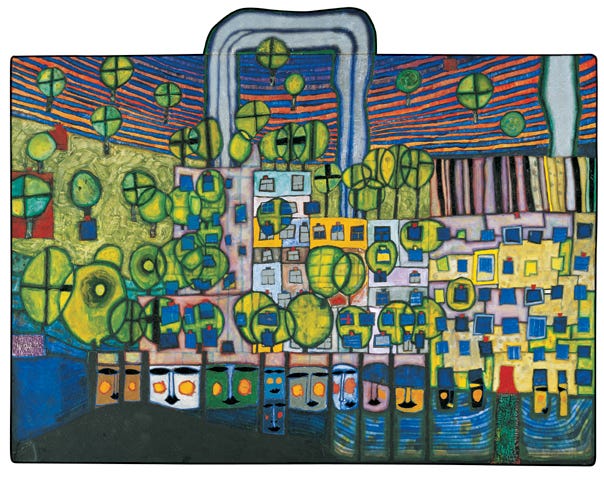
Hundertwasser believed that if we made an effort to create beauty and harmony in each layer, we would raise the vibration of our collective intellect, and thus be able to move our society in a better direction. Even back in the mid-20th Century, he recognized the importance of finding a balance between human existence and nature, and he rejected the Economic Man, who was “rational and egocentric”. For himself, he saw the way forward in an Ecological Man; a human whose logic is based in his Ecosystem.

The ideas of Hundertwasser are still considered radical today, but they also have provided inspiration and documentation of new ways to build and grow in harmony with the world around us.
You can learn more about his work, vision, and art here: https://hundertwasser.com/en
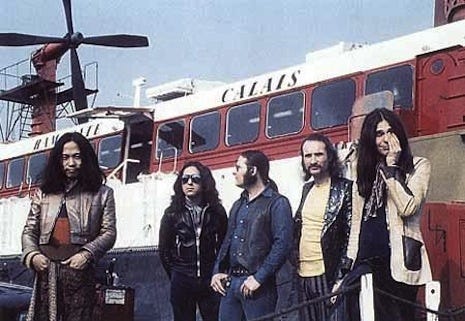
Music is extremely important to me, and one of my favorite bands is a German group who called themselves Can. Inspired by the work of Karl Stockhausen and other avant garde musicians in the mid-century, Holger Czukay, Michael Karoli, Irmin Schmidt, Jaki Leibzeit, sometimes with world-traveling singers Malcolm Mooney or Damo Suzuki, created a musical process of “spontaneous composition”, where there could be no mistakes. Whatever happened in a recording session was what the piece would be, including noises from outside like car horns, dogs barking, and rainstorms. Can’s music was ground-breaking, and little understood at the time they were making it, in the late sixties through the 1970’s. The people who discovered what they were doing were inspired by it, and took threads of their creativity into other areas of music. For one example, John Lydon, of The Sex Pistols and Public Image LTD, was a huge fan; and his bandmate in PIL, Jah Wobble, later collaborated with Czukay, Liebzeit, and Karoli.
Can never sounded like anything else that was happening musically in the world during the decade of their existence. Bassist Holger Czukay and guitarist Michael Karoli joined together in keyboardist Irmin Schmidt’s home (under the watch and care of Irmin’s wife Hildegard, who may be considered Can’s “muse”), where they met man-machine drummer Jaki Liebezeit. All of the players were intense musicians, who had studied with avant garde composer Karl Stockhausen and John Cage. The band did not have a name for a long time, until their first live gig. “Can” was chosen for its simplicity, and multiple meanings.
Playing spontaneously around the West African beats of Liebezeit, with each musician bringing their best improvisations to the project, the band began to garner interest (if not popularity) with their first album Monster Movie. The first singer, American Malcolm Mooney, left suddenly, and the band found themselves booked for a show with no singer. As fate would have it, Holger and Irmin spotted a wandering street busker named Damo Suzuki, who was walking down the street singing, praying, crawling, and dancing. He was so unusual, they immediately asked him to be the singer for the show they had to play that night. Damo’s appearance in their midst led to what many consider to be their most creative and defining period of albums. He sang in a made-up language with the mojo of a Samurai warrior. With his vocals, the band gelled.
The band has said in interviews that the only rule in the studio was to keep playing, because nothing was ever wrong, it was only a departure point to someplace new. None of their albums really resemble each other, although after the Musique Concrete of Tago Mago, they tended to flow into what could easily be considered the birth of Ambient Techno. Brian Eno has named them as being inspirational for him, as have many other musicians who came after them. It isn’t that simple, though, to describe their “sound”. You just sort of soak in it.


After Damo Suzuki left the band, guitarist Michael Karoli sang on a few tracks, and the band shifted to more instrumental music, with Karoli’s North African gypsy playing soaring and shifting over Liebezeit’s Yoruban ritual drumming, while Irmin ran rings around his keyboards, and Czukay eventually swapped his thrumming bass loops for a madcap assortment of electronic equipment that produced everything from random shortwave radio bursts to recorded tape loops and found noises. They finally split in 1979, but continued to work together and with other musicians, linking a network of artists who wanted to explore and create new music for the future.
You can learn more about how Can came together and what they created here:
https://www.spoonrecords.com/history/can.php
and here:
https://www.nytimes.com/2018/06/12/arts/music/can-book-all-gates-open.html
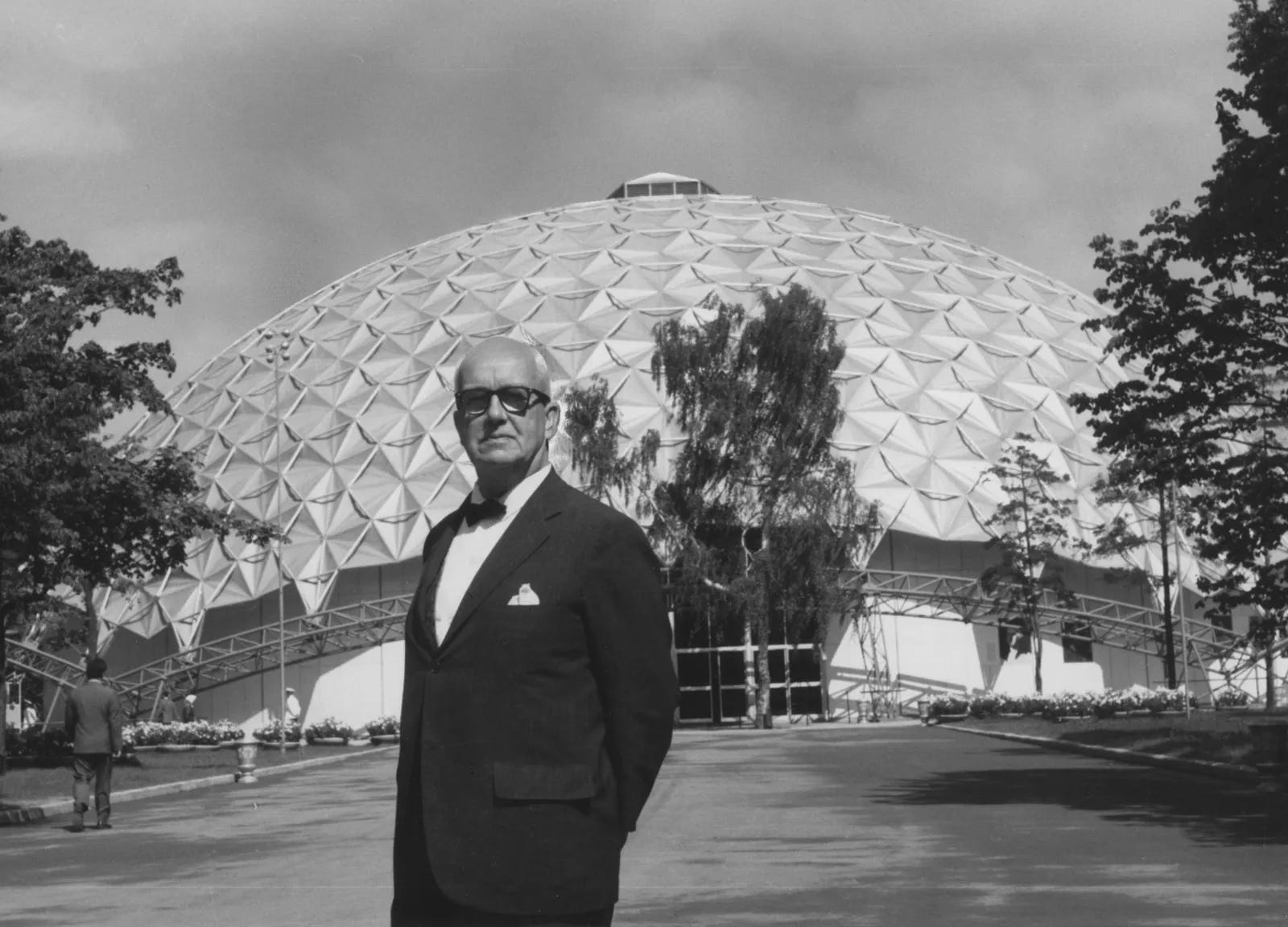
It is quite difficult to do a “short summary” of Bucky Fuller’s approach to life, science, and invention. He was a complex man full of contradictions and a selfless optimism. After several early failures in his life and career, he contemplated drowning himself, but ultimately came away from the despair with a mandate to make the most of his mind and his unusual methods of problem solving. He claimed that he experienced a strange, almost out-of-body experience, where he received this message: “From now on you need never await temporal attestation to your thought. You think the truth. You do not have the right to eliminate yourself. You do not belong to you. You belong to the Universe. Your significance will remain forever obscure to you, but you may assume that you are fulfilling your role if you apply yourself to converting your experiences to the highest advantage of others.” From that moment, he committed himself to using his brain for the good of humankind.
Fuller is best known for designing the architectural model The Geodesic Dome. This achievement came late in his life, after several great ideas which didn’t work out for various reasons. These included the Dymaxion (Dynamic Maximum Tension) products—a modular design for housing which would reduce the costs of building and materials, and a car with zero-point turning abilities and a more efficient motor. Once he was dedicated to his new approach to thinking, he settled at Black Mountain College in North Carolina, where his honorary Institute still exists today. He taught and collaborated with many people at different institutions throughout his life, bringing a fresh perspective and a language all his own to research and engineering projects wherever he went.

His original and unusual approach to learning is aligned with a Growth mindset. Fuller said his goal was to further "the search for the principles governing the universe and help advance the evolution of humanity in accordance with them ... finding ways of doing more with less to the end that all people everywhere can have more and more." He wrote many books during his lifetime, which are challenging and inspiring.
You can learn more about Buckminster Fuller here: